Showing posts with label food. Show all posts

Wednesday, May 7, 2014

In search of unknown fruit

  I love fruit and in Costa Rica I've tried quite a few that were new to me. Let's start with what is a favorite fruit and one I've only seen in Costa Rica: caimito. It's a sphere, purple on the outside and shading from purple to white on the inside. I like to eat it with a spoon as the texture is a bit like custard. A lot of Costa Ricans don't like it because it has some latex which makes your lips sticky. A tip I haven't had a chance to try yet: after eating caimito rub your lips with some oil to remove the latex. I find the flavor so beguiling that I don't mind some stickiness.

   Did you know that the cashew nut we eat grows on the outside of a fruit? Every nut represents a fruit, perhaps explaining what cashews are so expensive. Native to Brazil, Ticos and other Spanish speakers call the fruit and nut marañón.  People make a juice of the fruit and it's one fruit I just don't like. It smells bad to me. I'll stick to eating the delicious nuts.
   The following photo shows two fruits: the red manzana de agua or water apple and mamón. Water apples, originally from the Malay peninsula and nearby areas, are quite bland and juicy. I guess they would be really good to quench a thirst on a very hot day. Not a frequent need in Monteverde so I don't eat them often. Mamón, a South American native,  has a crisp shell around a large seed. In between the seed and the shell is a small layer of tart flesh. It's fun to peel the shell off with your fingernail and pop the insides in your mouth so you can gnaw the fruit off the seed. The fruit doesn't come off the seed easily so it's a good way to pass some time.
 Here's another picture of water apples, a grenadilla and some green jocotes. A fruit from the cashew family originally from Central America, jocotes are now also cultivated in Asia. You eat jocotes whole, skin and all. Perhaps I would like them better if Costa Ricans let them ripen but here they are sold while still green so they are tart. I think maybe people sprinkle salt on the them, the way they do with unripe mangoes.
  Grenadilla is a fruit related to passion fruit. The outside has a crisp, papery layer. Inside the many small seeds are each inside a small packet of juicy fruit.  I scoop the insides into a blender and run at top speed briefly. Next I use a sieve to remove the seed particles. The seeds are edible so a few bits of seeds getting through isn't a problem. Then I make a smoothy with some yogurt, sugar, and ice. It's very aromatic and quite similar to passion fruit.
 The following fruit is the one that inspired me to write this post. One of my English students brought some as a gift for me from her family farm. It is called rose apple or manzana de rosa. I've never seen this fruit for sale. It's  peculiar in that the seeds are inside a hollow space. The fruit is a bit crunchy and has an astonishing perfume like roses.

Sunday, June 3, 2012

The shock of the large

   Many things are big in the U.S. Consider the size of this strawberry from California. The egg is the standard large egg. It's just this kind of thing that sends me into reverse culture shock as I readjust to being in the States.
I used to scorn large strawberries as being generally hard as rocks and devoid of flavor. It seems, however, that there has been a lot of progress in strawberries and this strawberry had quite a bit of flavor. It was slightly on the crunchy side which helped it make it's trip without damage.
Happily, we are now in the very brief local strawberry season in Wisconsin. This is one of the average-sized, locally grown strawberries I bought today with the same size egg. (To be fair, I should have probably photographed the largest berry in the box, but it wasn't much bigger.)
The flavor: extraordinary.

Thursday, February 16, 2012

Lessons from my Costa Rican kitchen

Cooking isn't radically different for me in Costa Rica. It's easy to get many of my favorite ingredients such as pasta and olive oil. The fruits are fantastic and the vegetables, while limited in kinds, can be very fresh—although many of them come to market larger than I would prefer. (The average beet is the size of a large grapefruit.) However, certain ingredients are impossible to find—such as grapefruit. The fun part of the adventure is that some things are really different. These are some of the important things I've learned cooking in Costa Rica:

1. My gas oven has the numbers 1 through 4, indicating the size of flame.  Acting as the human thermostat, I check the temperature often, but fluctuations happen. It turns out that the exact temperature of the oven doesn't really matter as much as cookbooks say. And by the way, having the gas tank run out in the middle of baking something isn't necessarily a disaster. I even had a cake survive a massive drop of temperature when the tank ran out.
   I bake all of our bread because I like it a lot better than bread I can buy here.
2. Fresh home-made tortillas are great, especially when you can buy them at the near-by store when they are still warm. Make a cheese quesadilla, cut up an avocado and have a juice like watermelon and it's a fast and easy lunch.
3. You can make great brownies and cake with cocoa instead of baking chocolate. See my post about brownies.

4. Use what's available. Don't head to the store with a fixed idea of what you want; get what looks fresh or good. There are lots of good ways to cook carrots if that happens to be what you can get.
5. If you have a smaller fridge things don't get lost and don't spoil.

6. Instead of maple syrup, watered down guava jam is really good on pancakes.

7. I really miss tofu. I know it has almost no flavor but I still miss it. Best substitute for the tofu craving: texturized vegetable protein cooked with ginger.

8. Enjoy the fruit and try all the new ones you can. The fruits in this photo are sapote and grenadilla. Sapote is the only fruit I've had that I actually thought was too sweet. Grenadilla is similar to passion fruit and its juice makes a heavenly smoothy with yogurt. Just put the center part in the blender including the seeds, liquify and then strain through a sieve. The seeds are edible so having seed particles go through the sieve isn't a problem. They are ripe when the shell is dry and the seeds move around when you shake the fruit.

Monday, July 11, 2011

Just a tourist here myself

   I like to play tourist in  my regular stomping grounds and see things with a fresh eye. (There is nothing like being on a bicycle to help us notice the details; rest stops are an ideal time to explore places that in a car we would be whizzing past.)  This week we stopped in at the Cedar Grove Cheese factory in Plain, Wisconsin to see where some of our favorite local cheese comes from. We saw them shoveling sheep milk cheese.
It wouldn't surprise me to see enough cow cheese to shovel, but sheep aren't all that common in Wisconsin. The nice young man at the counter, an aspiring opera singer, said they produce over 10,000 pounds (about 4,5000 kilograms) of cheese a day. Most of it is cow cheese and they specialize in organic and rBGH-free cheese. Besides being shipped out in big trucks, some of their cheese goes all over the world via UPS. After sampling and buying cheese, refilling our water bottles, and enjoying the air conditioned store, we checked out their Living Machine next to the factory.
Cedar Grove uses tanks with natural microbes and hydroponic plants to clean up their wastewater so it's clean enough put it into Honey Creek. It processes about 7,000 gallons (26,000 liters) of water a day.
  A couple of days later, a very challenging hilly ride took us from North Freedom across the ancient Baraboo Range to Loganville. Even though two state highways intersect there, minutes can go by between vehicles; it's a very quiet little town. By the time we arrived, our packed sandwiches seemed rather paltry, so we were happy to discover Aunt Ozie's Cafe where we refueled with a tasty lunch including some of the best home-made potato salad I've ever tasted.
Across the street is Burmester's Grocery Store, where one can do a bit of time travel to a really old fashioned grocery store.
The stock is a little sparse; I wanted a candy bar and fortunately Mr. Burmester had several Snickers bars on hand.

Thursday, May 26, 2011

Cheesehead heaven

Yep, we're back in Wisconsin. I'm so happy to see vast arrays of delicious cheese at local stores.
True, there's plenty of cheese in Monteverde, but none of the artisanal cheeses that we have in America's Dairyland. No imported cheese is available in Monteverde either. I'm reveling in the selection here. This isn't even the entire selection at our local coop.
When we get some of this cheese together with locally grown tomatoes later in the summer, it will be even more heavenly. I saw these beauties in Tennessee on the way home. Most Wisconson gardeners haven't even planted tomatoes yet—it has been a very cool spring.

Sunday, December 26, 2010

The world-wide panettone movement

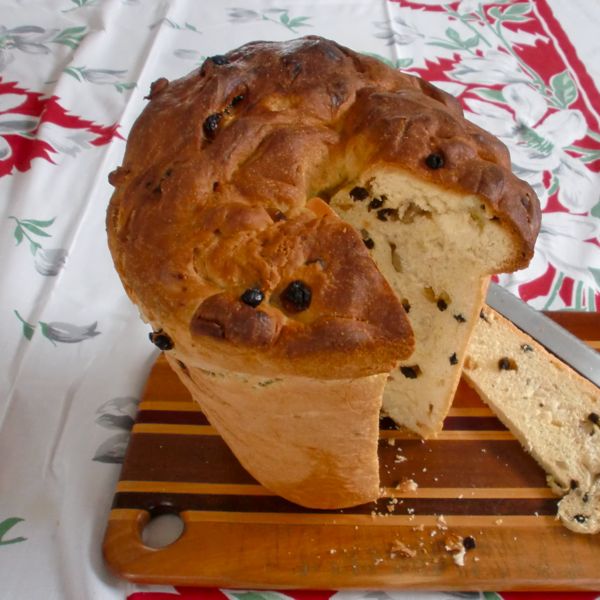
One of my holiday traditions is baking panettone, a type of Italian holiday bread eaten for both Christmas and New Year. It's a bread that is very popular in South America as well as Italy.
It's laden with butter and eggs in what is called an enriched dough. The ending "one" implies that this bread is big or special. You can buy panettone in fancy packages, but I'm suspicious of any bread that claims it can be eaten months after it is baked. Scary. Making homemade panettone is a bit of production because the dough must rest in the refrigerator overnight but it's well worth the effort. Like most bread, the hands-on time isn't long. (And if you have a heavy duty stand mixer, you hardly have to do any actual work.) If you make homemade panettone you don't have to eat mysterious red and green fruit pieces but whatever dried fruit you like. I pick two kinds from candied papaya, candied ginger, currants, raisins, dried cherries or cranberries. I've used walnuts, macadamias, pine nuts and pecans. I only use 2 kinds of fruit and some nuts, so the flavors don't get too confused.
   I make about 8 loaves a year and it's a gift that always seems to be appreciated. I've even given it to Italians and had them rave about it. I guess they were homesick. Of course, I have to do quality control every year to make sure I haven't lost my touch. Usually we do quality control on two loaves. Just to be sure.
Note on the mold. Panettone is traditionally made in a tall mold. Mine appeared unordered in a shipment of kitchen goods, as if to let me know that my destiny was to make panettone. I've been fulfilling that destiny for over 25 years. You can now buy one-time-use paper molds—or you can shape the dough into rolls. I've done that and it's delicious. Then I like to call them panettini.
  What's your favorite holiday baking project?

Panettone
2 T yeast
1/4 C warm water
1T sugar
Mix and let bubble. Add 1/3 C flour. Let rise until double.

2 1/2 C flour (bread or all-purpose)
1/2 tsp salt
1/4 C sugar
3 whole eggs
2 egg yolks
1 T + 1 tsp water
3/4 C softened butter (1 1/2 sticks)
1 tsp vanilla
grated lemon peel from one lemon or 1/4 tsp lemon extract or 1/4 tsp almond extract

Combine these ingredients with the ball of yeasted dough. Knead 10-15 min. Add more flour as needed, usually about 1 cup. (Your goal is to add a minimum amount of flour so the dough isn't dry.) Then add 1 cup total of dried fruit and chopped nuts. The best way to incorporate the fruit and nuts is to flatten the dough, spread on a layer of the fruit and nuts and then fold the dough several times. Let rise until double. (Enriched doughs often are very slow to rise. Be patient.) Punch down and refrigerate overnight, covered.
Punch down and place in buttered mold. Let rise until double. To speed up the action of this cold dough, I put the pan in a very warm place: on top of some potholders sitting on the radiator until it gets warm and starts rising. Bake 400 for 10 min. and 350 for 30-40 min.

Friday, October 22, 2010

They're all good

A major reason we love the Italian culture is the food.
After traveling quite extensively in Italy, I rarely consult guidebooks for help on choosing restaurants. For one thing, many of our travels in Italy have been by bicycle and a guidebook that covered the small cities we stayed in would be far too heavy to carry on a bike.
  There is also a more important and better reason. Once, we were questioning the guy at the front desk of our hotel in Pavia about good places to eat. He described several places and finally said, "Well, really, they are all good."
 The wonder of Italy is that it's true. In many months of traveling and hundreds of meals, we can recall only one really bad meal. (It was in Venice. One does need to be careful in Venice. There are very few Italians actually living in there because it's so expensive and the restaurants don't depend on regular customers.)
Our method of finding good places to eat in Italy:
1. Avoid any restaurant that has big photos of the food outside, large and prominently displayed tourist menus in English, or has a person encouraging you to go in.
2. Walk a little ways from a popular tourist site. Unless you are inside a tourist site, such as a major museum, which might have a quite decent restaurant which can be a good place to have lunch or a snack so you can see more art without fainting.
3. Look at the general appearance of the place and if people already eating look happy.
4. For a special night out, ask someone local. People working at hotels are excellent sources of info.
5. Don't worry about it too much. With very few exceptions, they are good.
For lunch, search out bars. A bar in Italy is a place not just for drinks and coffee, but for wonderful sandwiches. You can check out a bar by walking in and looking at the sandwiches and desserts in the glass case. If they don't look delicious, just keep walking. In small towns, bars don't always have sandwiches prepared in advance so go to the nicest bar you see, whose vibe attracts you. Or go to the only bar. It will probably be just fine.
Some bars require you to pay for your food first and give the receipt to the person at the counter who gives you the food. Don't worry if your Italian isn't up to the challenge. Bars in Italy tend to be staffed by cheerful people that want to unite you with food and drink. Many bars have someone who will help the bewildered tourist and many will have you pay after you have your food so you can create less confusion. If you want to sit down and eat, rather than at the counter, you will be waited on and pay at the end. If you need to, you can go point out what you want to eat and then go back to your table. If you are a tourist with tired feet, having a good sit down isn't really that expensive. Indulge yourself. If you are your feet don't hurt, stand at the bar and enjoy going native.
Italians are excellent hosts and usually very adaptable. You want to share a pizza even though Italians never do that? You only want a first course and a salad but no second course? You want your salad first instead of at the end of the meal? You want a cappuccino after dinner instead of at breakfast? Most Italian restaurants will accommodate these deeply strange requests without any fuss or comment. Or, as my Italian tutor told me, commentary will occur only in the kitchen.
  There are a couple of points of etiquette that non-Italians may not be aware of.  Meals are served in courses. So if only one person in a large group orders an appetizer all the other diners will probably wait until that person is served and has eaten the appetizer. Secondly, almost all food in Italian kitchens is cooked to order by a small staff. (If any frozen ingredients are used in a dish, it must be indicated on the menu.) Give the kitchen a break and do as the Italians do: if you are in group, order the same thing or at least limit the number of different dishes you order.
   Buon appetito and don't forget the gelato!

Thursday, September 9, 2010

Easy pieces

Way back when, when I was working crazy hours, I realized that time after time I got home too tired and too hungry to even decide what to cook. That's when I made my list of "5 Easy Pieces": dishes that took very little time to put together, yet we like to eat. (One of them was frozen pizza. This might give an idea of how little brain power I had left when I got home since I actually had to have this written on a reminder list. I just don't think well when I'm hungry. Another easy and fast dish was tempeh in coconut milk. The exoticism of that was balanced by macaroni and cheese out of the box which is one of Mr. Rududu's favorite foods in the entire world. )
  I don't know where that list is anymore. Happily, I'm no longer so pressed for time. But I often throw dinner together at the last minute on busy days. In the late summer with wonderful tomatoes available, a great option is Insalata Caprese.
 Get a really ripe and flavorful tomato. Slice it up and lay it on a plate with slices of fresh mozzarella cheese. Sprinkle on some basil leaves, salt, and pepper. Dress with olive oil and vinegar. Savor.

Sunday, May 23, 2010

Farmers' markets both grand and intimate

Madison has 8 farmers' markets throughout the week in various locations. I usually go to the market right in my neighborhood, held on Tuesdays afternoons. There are no crowds and I can get all the veggies I need plus butter and cheese in about 10 minutes. That includes having time to chat with my favorite vendors or friends I bump into. It isn't crowded, but still has extras like a musician.
Madison also has the largest producer-only farmers' market in the US. (That means the people who grew the food are selling it.) It's Saturday mornings around the Capitol Square. There are crowds.
It's big! It's an event and a tourist destination and if you go all the way around, it's about a mile. A mile of farm vendors—so it has everything imaginable that grows in Wisconsin. This week we got wild hickory nuts, all shelled and ready to put into pancakes. (They are to very difficult to shell but delicious.) And, as a special treat, we spotted these wood sprites.

Saturday, May 15, 2010

Our mushroom hunt

Because we returned so early from Costa Rica this year, I was looking forward to getting morels, a delicious mushroom that can be found in the Midwest. By definition, morels are wild; so far they have not been domesticated.
 Unfortunately, from the morel procurement point of view, it was very warm earlier in the spring and the morel season was mostly over by the time we got here. In past years we have gone to the Muscoda (pronounced MUSK-a-dee) Morel Festival. I called Mushroom Headquarters earlier in the week and learned that any mushroom seekers would be advised to arrive early on festival weekend. However, mushrooms were being sold daily at the Muscoda village hall. We decided on a preemptive mushroom foray on Friday since frankly none of us is that good at getting up and going places early. So my mom, sister, Russ and I went on a little car trip, hunting mushrooms. We arrived in downtown Mucoda.
I had reserved a pound when I called but not knowing how much my mother or sister would want, I assumed that even if supplies were limited they could get some. Wrong. There was one bag there in mushroom headquarters and it had my name on it. A test of my character (a morel dilemma?) loomed as I wondered if I was able to share my morels. We decided to walk around the village in the hope that more mushrooms would come in. First we looked at the entrants in the morel contest. (Not for sale.) These were entered in the "smallest" category. How did the mushroom hunter find them? Even spotting a normally sized one isn't that easy.

Muscoda is a quiet village but there was a certain buzz in the air as people prepared for the festival starting the next day. We met Captain Dirty Bad Bob selling books and cracking jokes. Since we have a pirate ancestor (and actually own a book to prove it) we felt we had a lot in common.
Bad Bob pointed out it was difficult to be descended from a pirate since many of them didn't live long enough to have offspring. I guess we were lucky—our pirate ancestor was captured in the American colonies and went straight in exchange for his freedom. He produced legions of descendants eligible to join the DAR as my grandmother did. After our walk around town and several garage sales, we checked back at Morel Central and were happy to find that a few more mushrooms had come in. As we rode home through the Wisconsin countryside we enjoyed the general lack of traffic and the excellent condition of the roads, as well as the beauty of the spring hillsides.

Sunday, May 9, 2010

Life is full of surprises

We're in Tampa, Florida for the weekend visiting our friends Tryg and Joanna. Joanna introduced Russ and me so she holds a special spot in our hearts.
We had lunch at a nearby Thai Buddhist temple called Wat Mongkolratanaram that sells food every Sunday as a fund raiser. Their temple is ornately beautiful and some people were inside chanting.
Even the decorative fruit is ornate.
There were lots of people there; the food is delicious and inexpensive. (The food is donated and prepared by volunteers.) Check out these huge woks of boiling oil to make fried bananas. These people are very cheerful considering how hot it was.
We had spring rolls, pad thai, fried veggies and some fried tilapia that reminded me of Lelo's in San Luis, Costa Rica. It was prepared the same way and tasted just as good as his.
Details
Wat Mongkolratanaram is open Sunday mornings from 10 a.m. to about 1 p.m. 5306 Palm River Rd., Tampa, Florida. 813-621-1669

Sunday, April 11, 2010

Shopping at la feria


Every Saturday since a year ago there has been a farmers market in the high school gymnasium. It's a great place to get fresh fruits and vegetables and see lots of friends. It being such a small town we always see people we know, like we used to at the Madison farmers market before it got so huge. However, the produce is quite different from what we get in Madison! There is a fruit vendor that brings up lots of fruit from lower altitudes. His papayas are much riper and sweeter than anything I've found at a regular store in town. I have to be careful carrying home so they don't get smashed.

This week I found something unusual--flowers of yucca quatemalensis. They are called flor de itabo. A young tico friend told me they are "old people's food." That could be because they are very traditional or perhaps because they are quite bitter. The vendor told me to boil them and then fry them with either eggs or tuna. I've had them at Marcela's house and they were delicious so I called and asked Marcela for instructions. My big question was whether to take out the center parts-the sepals--like the vendor said I should, or not. It's pretty time consuming to take them out and fortunately Marcela told me it was OK to leave them in. They are the more bitter part and we liked them.
These fruit are fresh passion fruit, maracuya. The vendor said they would be good in cake. I got further instructions from a tica friend who is a chef that I saw at the feria. I'll be trying to make something with them today. Meanwhile, they are filling our house with a heady aroma.
Life in a different country often presents mysteries. What is this huge pile of lastre (mixture of dirt and rock) doing in the parking lot of the school? I'm sure it will go on some road in the area as fill but why are they piling it up? Are they putting any on the street near our house?
I finished the first sock of this pair. I love the way the colors change in this yarn. These socks will be fraternal--I didn't start the second one with the same color.

Thursday, April 8, 2010

Visa Vacation: Mexico

Because we are in Costa Rica on a tourist visa, we have to leave the country at least once every 90 days. When we re-enter the country after at least 72 hours we get a new tourist visa. This means we take one "visa vacation" a season. It's a good thing because we enjoy it so much here we might never explore other places otherwise. Past vacations have been to Nicaragua, Guatemala, Panama, and Peru. Twist my arm, I need to take a visa vacation! This year we went to Mexico for the very first time. We took an Exploritas trip -- the organization was formerly Elderhostel. Now we like to call it Exploritis because if traveling is a bug we definitely have it.
The theme of the trip was birding the Mayan ruins of the Yucatán and we had a marvelous
time. We saw almost 200 species of birds but we liked it that our fellow travelers weren't fanatical. Most of the species we had seen before but we did pick up a few new ones that are endemics to that area. Now if one of us would just organize our various birds seen over the years into a life list....
Mr. Rududu managed to get lots of terrific bird photos even though he had to
keep up with the group. My favorite photo is this one of painted buntings.

Of course, we also really enjoyed seeing lots of Mayan ruins and learning about them from our excellent archeology guide. (We also had a birding guide and driver to take care of 14 people in the group.) There is incredible variety from one site to another. There was a lot of ornamentation on some of the buildings like these at Chichén Itzá or the facade of a huge building at Kabah.


Another real surprise were the colorful murals at Bonampak. Exactly how they made beautiful and durable blues and turquoises is not understood as far as I know but it did involve using vegetable dyes like a kind of indigo.

It was quite hot most of the time and one day it got up to 41C / 105 F. That's really hot for visiting archeological sites. Thank goodness for our air-conditioned van. Mr. Rududu bought a very nicely made Panama hat. It's called a jipi-japa. (Sounds like hippy-happa in English.) It stays on well even in a fairly stiff breeze. I

bought the first hat with a brim that I found, which isn't nearly as elegant but served very well its purpose of keeping me from keeling over in
the heat.
Of course, I pursued my interest in food. My favorite food experience of the trip was buying a roll from this vendor with his wares on a bicycle. the variety struck me as typical of a certain exuberance. On the right are a some chicken specialties of the area, which are wrapped in banana leaves and baked in a hole in the ground. Our group had that for lunch one day, except me because I don't eat chicken. I got a very good fuss-budget's special.


Our trip was well organized and very educational as well as fun. Our traveling companions were easy to get along with. In honor of what I saw I am naming my latest knitting project Mayan Dream. The stitch pattern, although I created it before our trip, reminds of the ornamentation on the buildings we saw and the turquoise reminds me of the Bonompak murals. I'm knitting with 2 colorways of Kauni yarn.