Wednesday, February 16, 2011

A winning Scrabble team

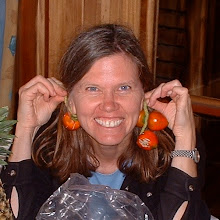
Why are all these Scrabble players so happy?
To explain, I first need to give you some background because we play Scrabble differently in Monteverde. (Hang on to your hats, Scrabble fanatics and please remember that it's only a game.) There have been regular Scrabble sessions here for many years—about 50. Some currently active players have been playing weekly for almost that long. Not surprisingly, over the years, some local variations of the rules have evolved.
   Several years ago Mr. Rududu and I started attending the Friday afternoon sessions and were introduced to Monteverde Scrabble culture. If you play competitive Scrabble or even just follow the rules on the box, you may be shocked to hear we play with eight tiles (not seven) and reuse blanks. For example, if a blank is on the board represents an N, and you have an N, you can swap it for the blank. You must, however, use the blank on that turn. While Monteverdean players are an exceptionally tolerant lot, a sure way to annoy people is to let them know you have a blank and then hold it in your rack for a long time.
   There is also a list of two and three letter words that are not legal Scrabble words anywhere else. They were found in the Oxford English Dictionary by a local Scrabble player who apparently felt there just weren't enough short words in the regular dictionary that almost no one knows the meaning of.  I think the list predates the use of the official Scrabble dictionary here. These special "Monteverde words" are listed in two little black books available during play. Speaking of that, the games are completely open book. There are numerous dictionaries and "cheat-sheets" available and fishing for words by reading a dictionary is common practice.
  To me, the most notable thing about Monteverde Scrabble games is how cooperative people are, perhaps because most of them are Quakers. Of course everyone likes to win and some people care about it more than others. Yet everyone seems to care a lot about the score you get when you add everyone's score together. The minimum goal of 600 is usually reached. Every once in a while we get up to 700. Last week the group pictured above got 814 on a single game! That involved two "Scrabbles" where someone played all eight of his or her letters and got 50 bonus points. As the game went on and it was evident they were going to get a big group score, there was more and more cooperation and brainstorming for what word each person should play.
   Here's a picture of the board. (Qri is a officially sanctioned Monteverde word, in case you're wondering. I have no idea what it means.) Here's part of their score sheet. Congratulations to the 814 team.


Sunday, February 13, 2011

¡Feliz dia de la amistad!

In Costa Rica and some other Spanish speaking countries, February 14th is celebrated as El dia del amor y la amistad or Day of love and friendship. I like that is has been broadened to be not just a day for sweethearts, but also a day for all friends.
  Here's a couple of friends I photographed in our yard yesterday: Blue-crowned motmots sitting on a sunny branch in our tree. I think they must nest nearby. They come and eat banana at our feeder, especially just at dusk and in the early morning. At dawn they make a soft and deep hoop-hoop call that gives them their name.
  While sitting still, they often slowly move their racket-tipped tail back and forth like the pendulum of a clock, earning them the nickname of pajaro reloj or clock bird. Another nicknames is bobo or fool because they are so trusting of humans. It doesn't seem to be a disadvantage to them because they are common in most parts of Costa Rica and have a range that includes Mexico, Peru and Argentina. They tend to sit still for long periods of time as they scan the area for prey such as large insects and small reptiles and amphibians.
  This species of motmot is one of my favorite birds. The iridescent head feathers and the shading from color to color are equally exquisite in both female and male. Because they are tame and sit still for long periods they are easy to see and photograph. Relatives of kingfishers, they dig long, winding burrows in the ground for their nests. The burrow can be 5 to 14 feet long (1.5-4 meters). Both parents feed their chicks.
They don't seem that foolish to me. ¡Feliz dia de amistad mis amigos!

Thursday, February 10, 2011

My heros: the trail builders

  A nice long hike in the Monteverde Cloud Forest Reserve brings me a deep feeling of peace; for me it's a form of meditation. This morning we caught the 7:30 bus up to the reserve and spent all day on some of the more than 6 miles/10 kilometers of well maintained trails. Among the things I meditate on as I hike is all the work that has gone into creating and maintaining the paths. Today we came upon the trail crew taking a well deserved rest and I asked them to pose for me. Most of the trail guys are not particularly large but they are incredibly tough.
   Over the years, the style of trail building has changed. The first time we hiked in the Monteverde Reserve in 1991, the trails were "cookies" or cross sections of fallen trees, usually covered in wire mesh. Cookies who have lost their mesh are incredibly slippery if wet and they are usually wet because they are in a cloud forest. In between cookies, there were places where we sank in mud almost to the top of our tall rubber boots. These days, that will never happen to you on the trails in the Monteverde Reserve; any good walking shoes are fine.
  Many of the paths are now paved in cement blocks. They are taken by truck to trail heads and carried  as much as a mile/1.6km. on someone's shoulder. Considering the hilly terrain, carrying a couple of cement blocks that far—and I've never seen a trail worker carry just one— is impressive indeed. Bags of fine rock are also carried in to fill the holes in the block. Just thinking about doing that all day makes my knees hurt. In this photo of blocks by a path being improved with cement blocks, you can see some old cookies too.
  In the last few years the preserve has changed to a new style of paths without steps. They install an edge of recycled plastic "wood" and fill the path with rock and fine gravel. This makes the paths a tiny bit more handicapped accessible and lets the trail builders transport some materials part of the way on a sort of wheelbarrow.  However, there is still of lot of human power used in carrying these sacks of fine gravel.
So as I walk along the trails, I'm not only grateful to be in a such a beautiful place, I am immensely grateful to the trail crew. ¡Gracias, amigos!

Sunday, February 6, 2011

Monkey business

  A large mammal recently came to our bird feeders. It was a White-throated Capuchin (cebus capucinus) monkey. Although it has a pink face, it is usually called the white-faced capucin or mono cara blanca. The corner of our lot has trees adjacent to a large wooded area running down to a stream so there's no reason that monkeys can't travel from tree to tree right up to our house. Monkeys have not come to our house often and we had personally only seen one at a distance which was acting quite fearful. Extreme alertness and caution is normal monkey behavior around people.
  Thus, I was surprised to look out the bedroom window and see one staring back at me from a branch a few feet away. He jumped up onto the roof, ran down the downspout and leaped onto the little platform where we put fruit out for the birds.
When he arrived, only peels that the birds won't eat were left. He took these banana and papaya peels to a nearby tree and seemed to relish them.
Then he came back for desert: a long drink from the hummingbird feeder. When he approached me as I snapped photos, I found his lack of fear of me a little alarming. Monkeys that have become habituated to people can be a real nuisance and although some people feed monkeys, it's not a good idea. Seeing monkeys is fun, but I would rather see them acting normally in the wild.
He unhooked the hummingbird feeder and took a long drink. When he was done, he unceremoniously dropped it. Next stop was back to the balcony and the other hummingbird feeder. When he dropped that one, a couple of perches broke off. Then he spent a long time licking off his hands and feet, where were covered in sugar water. Having taken a bunch of photos, we decided it was time to discourage his bad habit of associating with Homo sapiens. He didn't seem to really care, but a garbanzo bean from the sling shot was enough to make him retreat a bit. Also, all the food was gone.
   Mr. Rududu had a clever idea to discourage vandalism of the hummingbird feeders: backpack clips. Time will tell if they can use their partially opposable thumbs and intelligence to unhook them. If monkeys come often, we will need to completely reassess our bird feeders.

Thursday, February 3, 2011

We mammals like a sweet drink

   Lazy or tired birdwatchers can take a seat and enjoy the Hummingbird Gallery just outside the Monteverde Cloud Forest Preserve. You can sit and watch dozens of hummingbirds zipping around to numerous feeders. As far as I know, no one has ever been impaled by a hummingbird but they often fly close enough to graze your head with a wing. (The Hummingbird Gallery also has a nice gift shop and a great free exhibit of nature photos by Michael and Patricia Fogden.) Sheltered from the wind, the patio where the feeders are is nice and warm if the sun has come through the clouds. It's particularly nice to grab a cup of the best coffee in the area at the Cafe Colibrí next door and do some birding from a seated position after a morning of serious hiking.
  When we were there recently, an olingo (Bassaricyon gabbii) came to one of the feeders and had a nice long drink of sugar water. Martín, who works in the gallery, told me the olingo usually visits once a day in the months of January and February. As he remarked, this particular olingo must be the most famous in the world because it makes such an easy photographic subject.
Before you typecast this mostly nocturnal mammal for its fuzzy cuteness, consider this information from Mark Wainwright's The Natural History of Costa Rican Mammals:

"One in Monteverde was seen chasing down a variegated squirrel and killing it with a series of bites to the back of the head. Another Monteverdean individual, which frequently arrives to steal sugar water from feeders at the Hummingbird Gallery, also snags the occasional hummingbird, a demonstration that has horrified more than one group of feeder spectators."

We did not witness any predatory activity but we were quite amazed with how much sugar water he consumed. Olingos also drink nectar in the wild, but I'm sure they never find any other source that is so large. 


Monday, January 31, 2011

Word spreads...

   We live in a town small enough to have no local newspaper or radio station. The way you know what's going on is to talk to people and a whole lot of information sharing goes on. (Most of it is just gossip and one had best be very careful about what one says, because what goes around comes around.) Occasionally there is an actual newsworthy event. This past Friday, Prince Akishino, the second son of Emperor Akihito, and his wife Princess Kiko arrived in our little town by helicopter. It made an interesting case study in how we find out what's going on.
   My first hint that something was up was that 4 policemen were stationed on the road in front of the fanciest hotel in the area. I make a habit of not taking photos of heavily armed men, so I have no photo of them, but they were evenly spaced along the main road. This made us think someone very important was staying there. (When the president of Costa Rica came here several years ago, he was only attended by a few policemen and wandered freely in the crowd.) Next stop was the mini-super where someone said it was the Prince of China. China being a Communist country, that seemed a little unlikely. Getting news purely by word of mouth doesn't guarantee accuracy.
   The next day I was downtown and saw a huge entourage of motorcycle police and cars blocking the main street. I saw a group of Asian people going into my friend Angel's Fauna Glass gift shop. There was a lot of horn honking by people wanting to get down the main street and again talk of the "Prince of China". The prince was accompanied by a fire truck. Seeing a fire truck here is odd since the nearest fire station is an hour and a half drive away; they only come up here to douse the embers of really big fires. Still, it added a certain official festiveness to the scene. Or maybe the prince has a morbid fear of fire?
Next stop was the Chunches book store, where Deb agreed with me that the prince was probably someone from Japan. Or maybe Korea. She told me she had heard a helicopter and had taken her son over to the plaza to check it out. I think they were more interested in seeing the helicopter than seeing important personages.
  At home I searched the internet and found out who it was. Later that afternoon I saw an escort of police motorcycles, many honking cars, and the fire truck blaring its siren as they all went down the main road. That's how I knew the prince and princess only stayed with us one night. Talking to another friend the next day, I learned that her husband, a guard at the hotel, spoke with the Japanese ambassador to Costa Rica and he passed along the news that due to jet lag, the prince awoke and bathed at 4 a.m. and breakfasted at 5. Almost everyone I talk to commented that it would be a drag to be a prince and not have any privacy or be able to go anyplace alone.
  I can't wait to invade the prince's privacy further by talking to Angel and finding out what happened in his shop.

Friday, January 28, 2011

Leaping squirrels!

   Anyone with a bird feeder has squirrel problems—and that includes fruit feeders in Costa Rica because tropical squirrels love bananas as much as northern squirrels love sunflower seeds and are just as gluttonous. Bananas are quite inexpensive close to the source so we put out as many as 8 in one day if we are home all day. The birds come in droves. We've had 16 different species come to the feeder. Now that the trees I planted nearby are large, birds feel much safer hanging out nearby. Here's a big flock of Blue-gray tanagers.
 The Güitite trees (Acnistus arborescens) themselves provide a lot of fruit during part of the year. They are in the Solanaceae family and their fruits look like tiny tomatoes. They provide nectar to hummingbirds and attract many insects, also eaten by the birds.  The squirrels see their branches as convenient super highways to run along the branches so they leap onto the bird feeder.
  Here's a Palm tanager and a Blue-gray tanager at the feeder.
  The squirrels here are a tropical species called the Variegated Squirrel (Sciurus variegatoides) which means they come in different color combinations in different parts of Costa Rica. Our local variety is very handsome. Our tactics to defend the bananas against the squirrels include running out on the balcony waving a broom and yelling. I like to yell "Jump!" and see them perform like trained monkeys...I mean trained squirrels.
 Unfortunately they still require some training: sometimes I have to push the squirrel with the broom. Mr. Rududu's preferred weapon is a pea shooter. I was worried it would hurt the squirrels but even when he makes a direct hit they don't really seem to care that much and only retreat for a few seconds. And truth be told, Mr. Rududu needs more practice with the pea shooter.  The sling shot was a total bust due to problems with accuracy.
  All this jumping makes a squirrel very tired. Sometimes he just needs to lay on a branch and take a siesta.